/.metanomicon — the seed is the identity
v1.0 → v1.2 · four strata by hand, three by the squad
v1.0 made the field a dated instance of a law: same date, same climate. This round lets the date reach further in. The moon now seasons the field's palette and breathes its asymmetry; the mark behind the cloth is composed of today's weather; the moon-disc became a primitive with exactly three uses; and a day can be sent as an address and cited as a frame. Every claim carries a measurement, and one long-standing claim was found false on the way.
The squad that was meant to build this — a planner, seven builders, sixteen reviewers, a polish pass — returned nothing: every agent was blocked at the session's permission layer before it could read a file, and the account then hit its usage limit. The four strata here were built directly in small committed steps instead. Live at the design system, v1.1-seed-identity.
| Stratum | Placement | Status | What was measured |
|---|---|---|---|
| A · tide ← moon | the field | shipped | warm/cold energy at one instant: 0.12 new moon, 8.30 full, 2.45 waxing against 0.51 waning; unbound page hash-identical to neutral |
| B · the mark of today's weather | hero | shipped | 303 lattice cells constant across 30 offsets spanning the whole noise domain; 30 distinct renders; spread 1.855×; byte-identical on repeat |
| C · the phase disc | rail · rail foot · gate | shipped | three discs, zero grey pixels; reader's disc 0.516 at mid-page; control's disc 0→1 with the slider |
| F · the seed as an address | ephemeris | shipped | two fresh contexts at one ?date=: field hash 1146480644 in both; meta tags match; clipboard holds the citation; control 45px |
| the disagreement palette fires | the field | falsified → measured | thresholds 0.10/0.055 never reached in this noise (max 0.050 over 15,147 cells); reset to p85/p72; tint capped at half saturation |
| D · the King Wen dither | §09 plate | shipped | residual variance 3.5–5× higher, power below tile 13.27% vs 0.80%; raw 4×4 variance only +2.3% — the prediction half right, as stated before the run |
| E · the almanac | §09 plate | shipped | lunations at lag 29: 0.907 vs 0.915 for the moon; 13.8% of variation is the page's terrain; zero essence, zero grey at three rasters |
| G · the figure, played | §09 plate | shipped | no audio node before the gesture; double-press and 8-click hammer, 0 errors; reduced motion static, 6,076 lit px |
| the ephemeris observer | §09 | falsified → measured | the canon said 0°N 0°E; the code computes at the Royal Observatory, 51.4779°N — caught by the figure-player's builder |
The tide is the moon — four phases at one instant
The same field at the same t, differing only in the sky. Illumination seasons the agreement cells: cold-led at new moon, warm-led at full. The quarter breathes the asymmetry: waxing lowers the warm threshold and raises the cold one, waning does the reverse — so at equal illumination the first and last quarter tint differently. --lunation: 29.53d joins the beat and the sweep as the canon's third period.
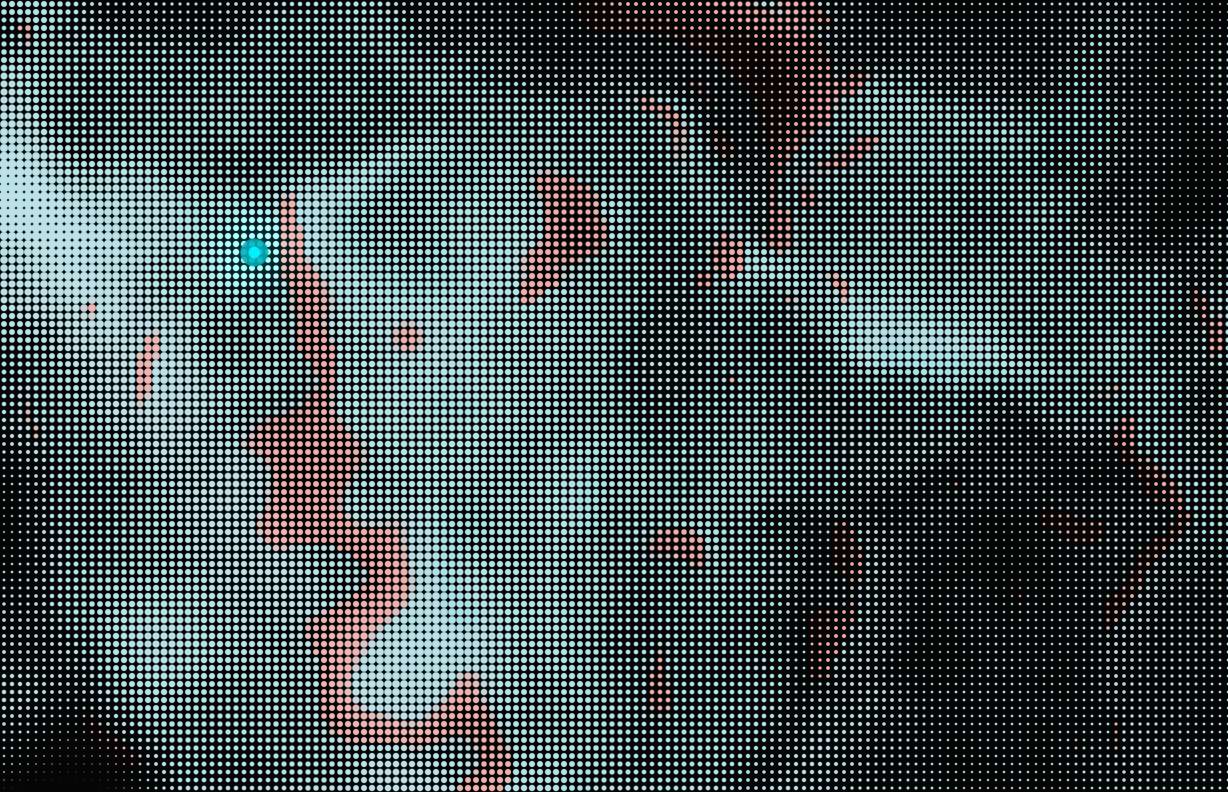
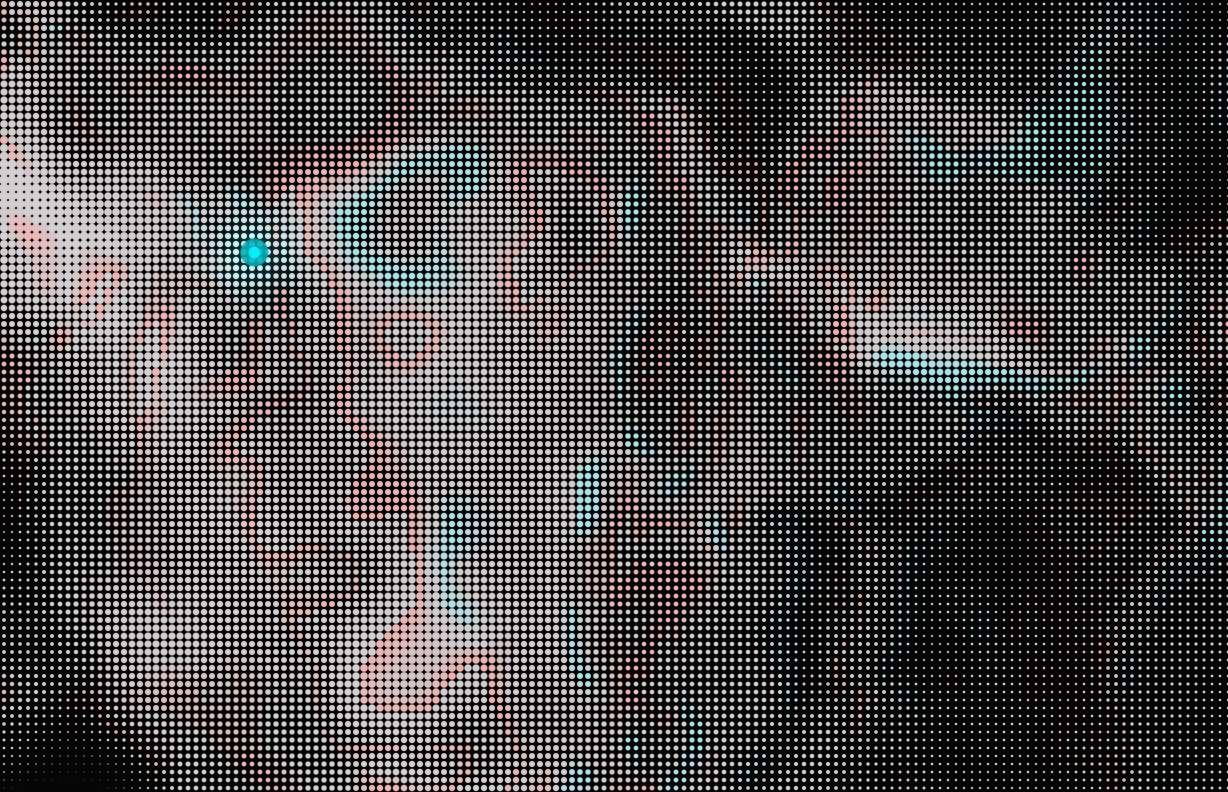
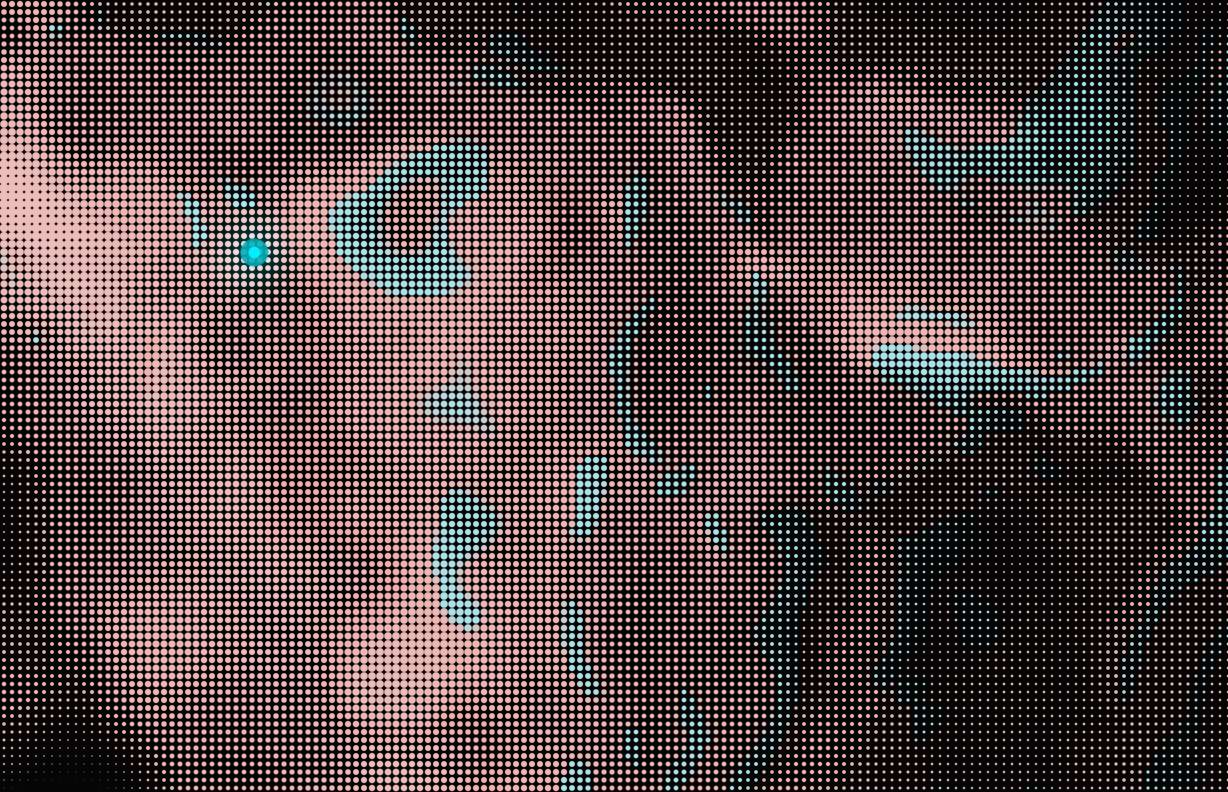
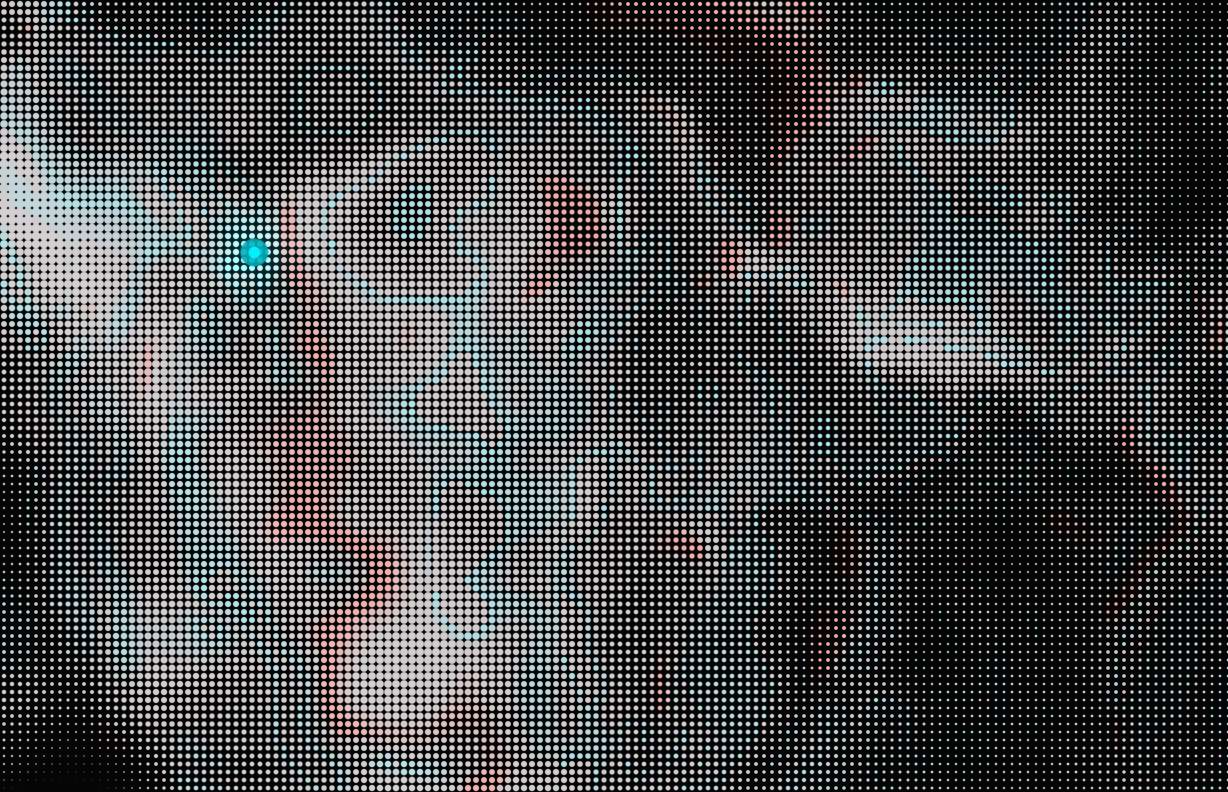
The disagreement palette had never fired. "Warm leads a rising contour, cold trails a falling one" was documented since the field shipped and was not the behaviour on screen: the thresholds belonged to p5's noise, and against this one |df| never reaches half the lower bar. Every tint had come through the agreement path, warm-biased. The thresholds are now the measured 85th and 72nd percentiles, the method the 1-bit solid uses.
Full saturation. At full disagreement the cold tint read as essence at a glance, and the hero's cyan budget is one living dot. Capped at half, as the solid caps its terminator. The direction stays legible; the impersonation does not.
Identity. A page with no ephemeris renders bit-identically to the neutral state — the moon is added on top of the old field, not in place of it. Lit-cell count varies under 1% across the four phases: the moon moves hue, not density.
The mark is made of today's weather
The cloth hero's copy always said the phantom was "resolved out of dots, never painted as a shade." Its code painted a typeset glyph at 52% opacity. Now the glyph is rasterised once as a mask from its own computed style and thrown away; what survives is the list of 8px lattice cells inside it, each a witness mark whose radius is the field at today's seed — the ephemeris's own noise-domain offset. Same date, same mark. The identity is a dated instance of the same law.
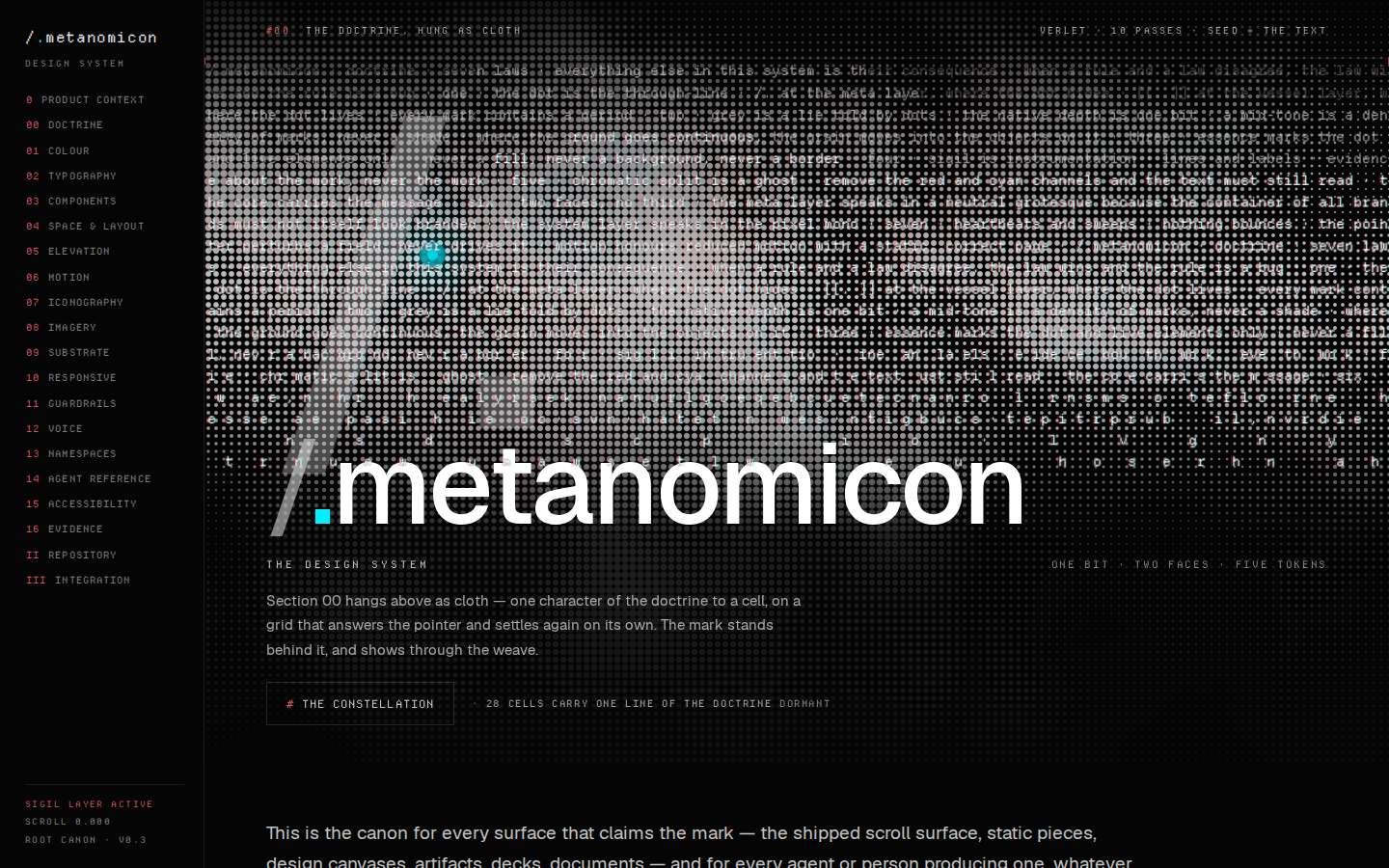
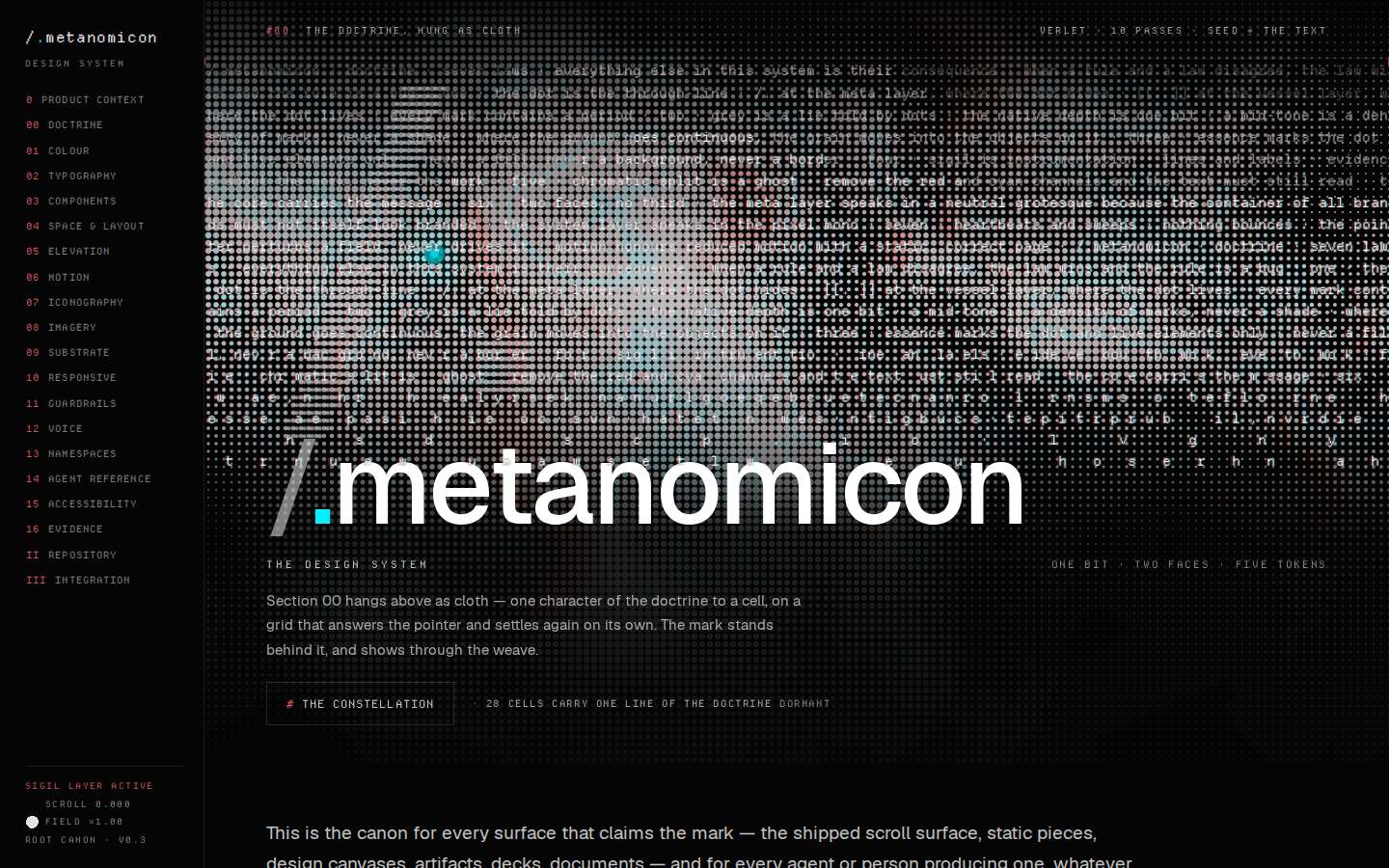
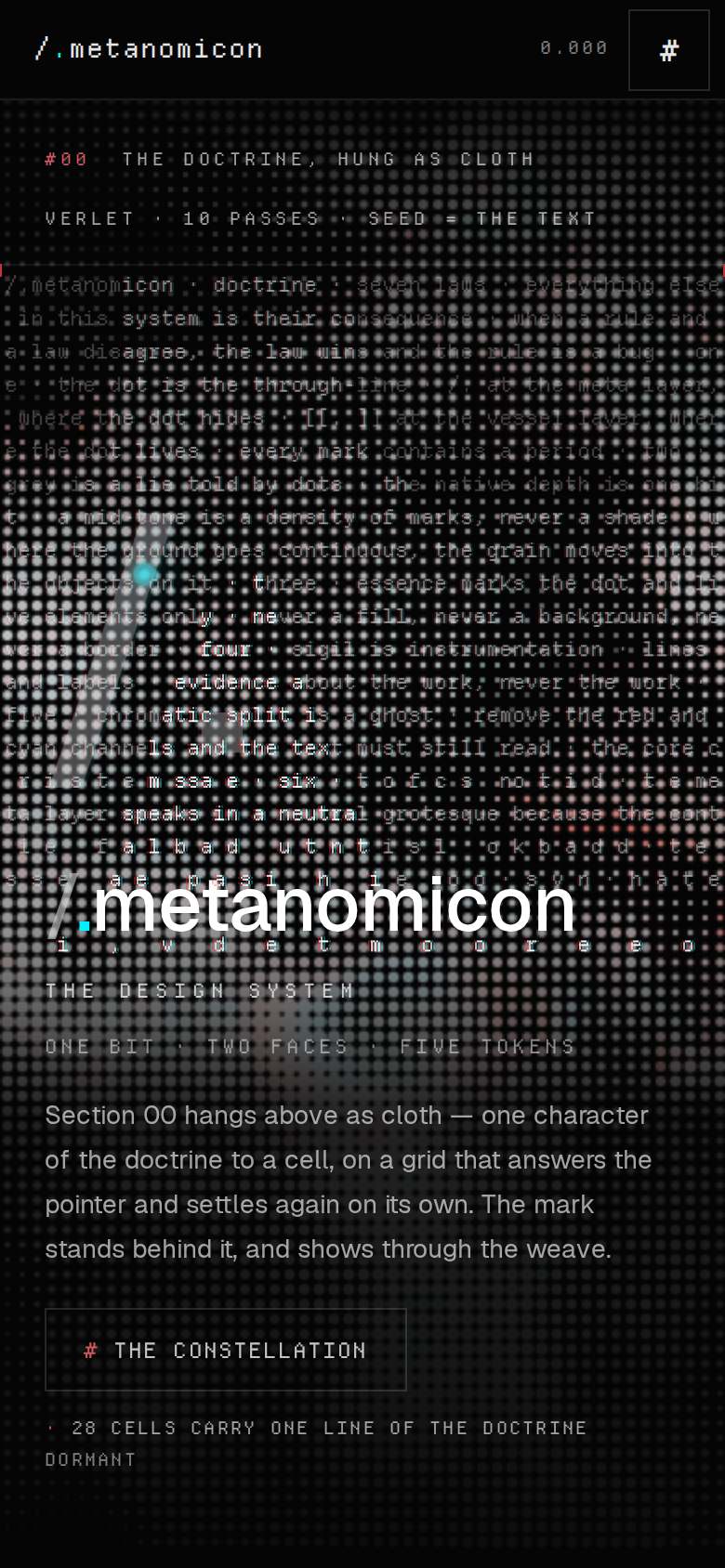
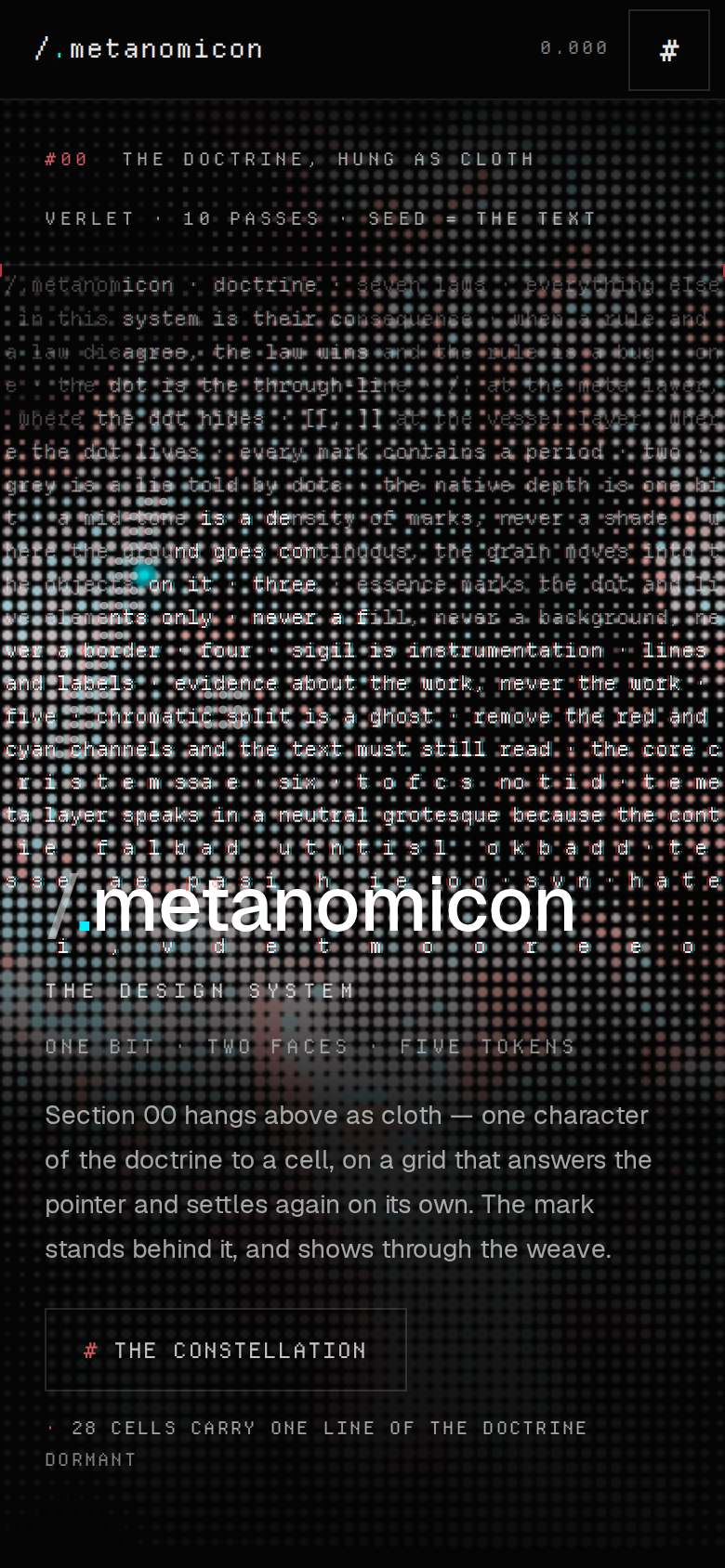
55–100% of R0. Thirty offsets on a grid over the whole noise domain — stronger than thirty consecutive dates, which cluster. 303 mask cells identical on every one; thirty distinct renders; lit-pixel spread 1.855×; byte-identical on repeat. The 0.44 coefficient the earlier evidence named as "chosen, not derived" is now actually applied.
Camouflage. The first render sat the mark's cells on the same lattice as the field's at similar radii, and a dotted glyph over a dotted ground did not separate. The cells are interleaved by half a pitch so they fall in the field's gaps, and the canvas runs at 0.72 rather than an opacity tuned for a solid glyph's luminance band.
Transparent ink is not text. The DOM glyph stays as an aria-hidden scaffold that sizes the box and is what the mask is read from, with its colour at alpha 0. The contrast review now skips fully transparent ink instead of the page keeping a shade to satisfy it.
The phase disc — one primitive, three instruments
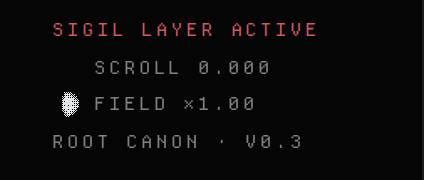
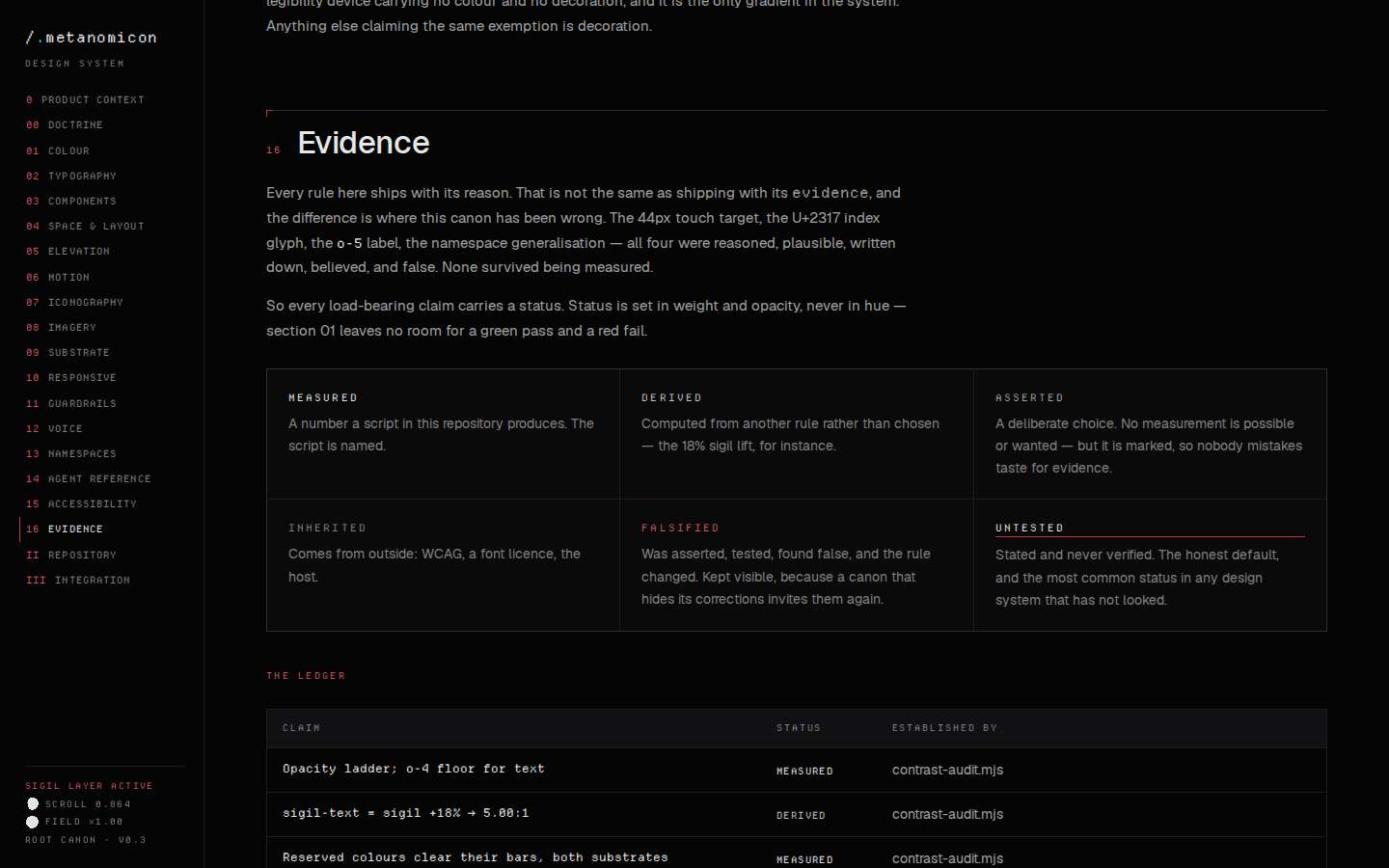
The moon-through-the-gate is one function now: a 0..1 quantity as the lit fraction of a dithered disc with a real terminator, the phase solved from the value. Used exactly three times — the reader's position, the machine's state, the reader's control — and the copy says why there is no fourth.
The seed as an address
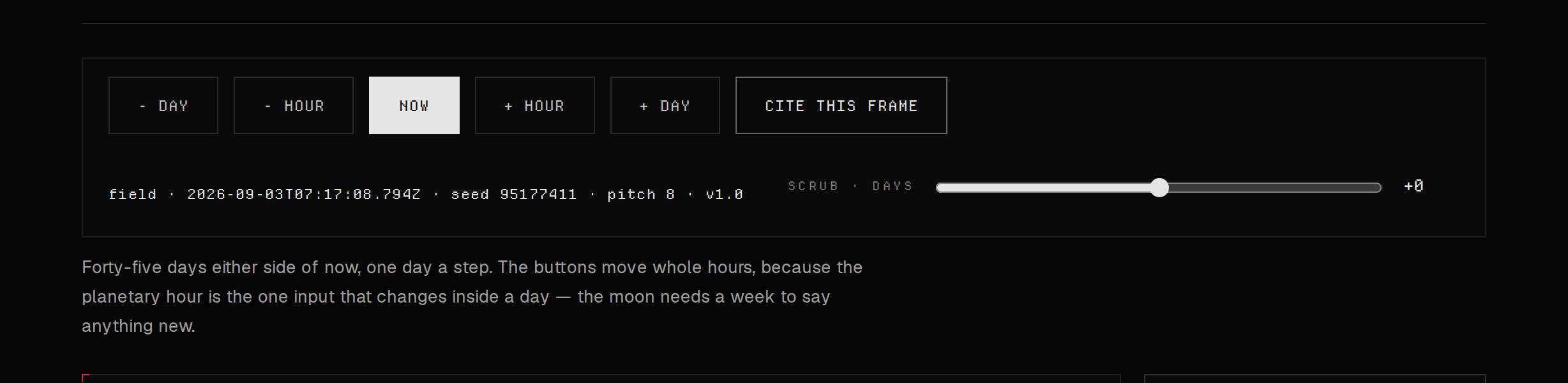
?date=<ISO> opens the page at that climate — a day can be sent. The ephemeris writes its state into <meta name="metanomicon:date | seed | citation"> so a machine reads the day without running a frame. "Cite this frame" copies the citation Part III demands, and the note beside it rises and settles over one beat. Two fresh contexts opening the same address rendered a byte-identical field — the first time the page has demonstrated same seed, same output rather than asserted it.
The evidence ledger
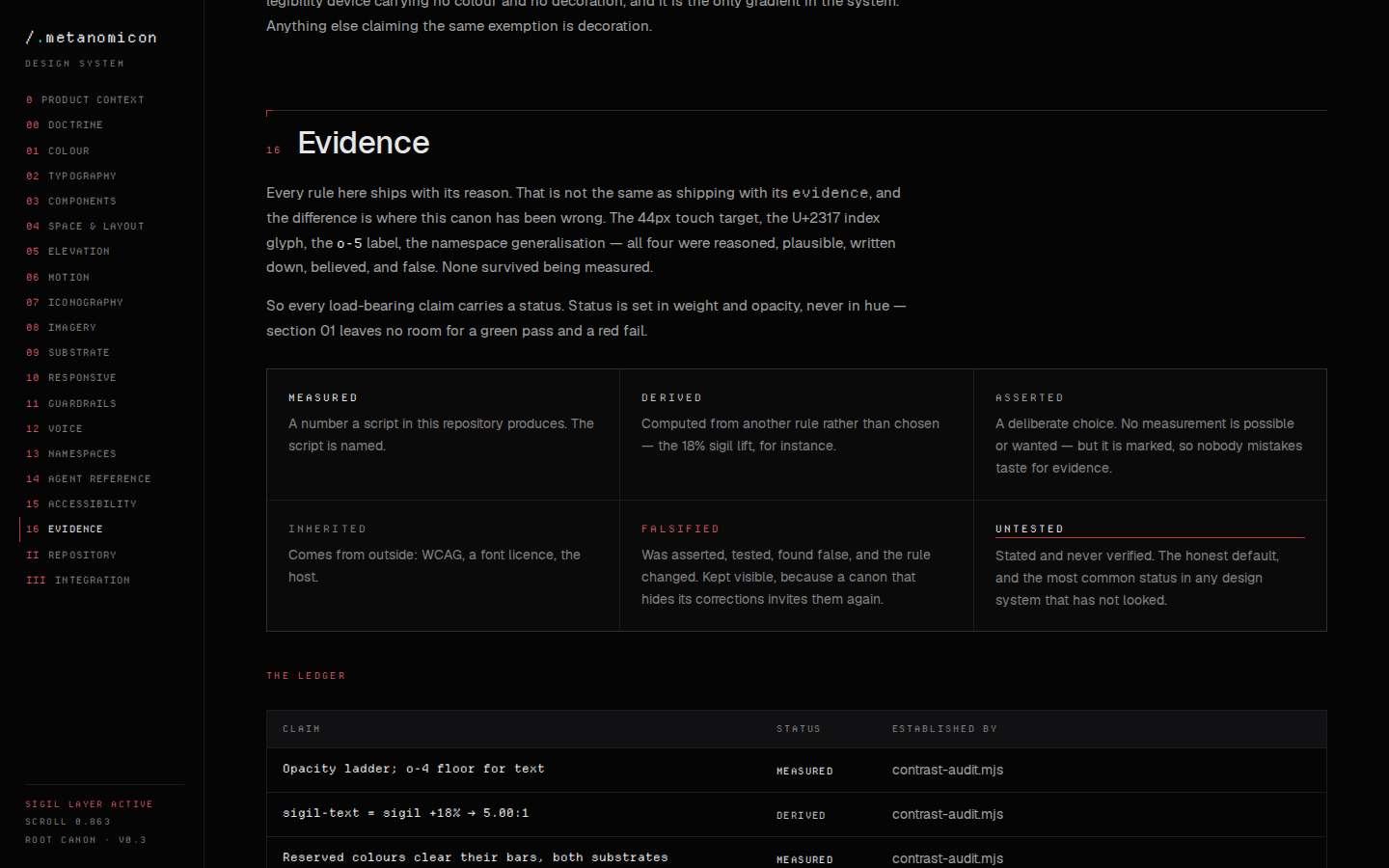
Six rows were added, one of them the correction. A canon that hides what it got wrong invites the same gap again.
The King Wen dither — the I Ching gate as evidence
Built by the squad once its tools worked: three builders, six adversarial reviewers, fixes applied in place and re-measured. The received sequence re-orders the same sixty-four thresholds at each figure's trigram address. The table is checked structurally — 28 of 32 consecutive pairs joined by inversion, the eight self-inverse figures in the remaining four pairs joined by complement. The prediction was written before the run: it will clump. It was half right, and the half that failed is the statistic the brief named.
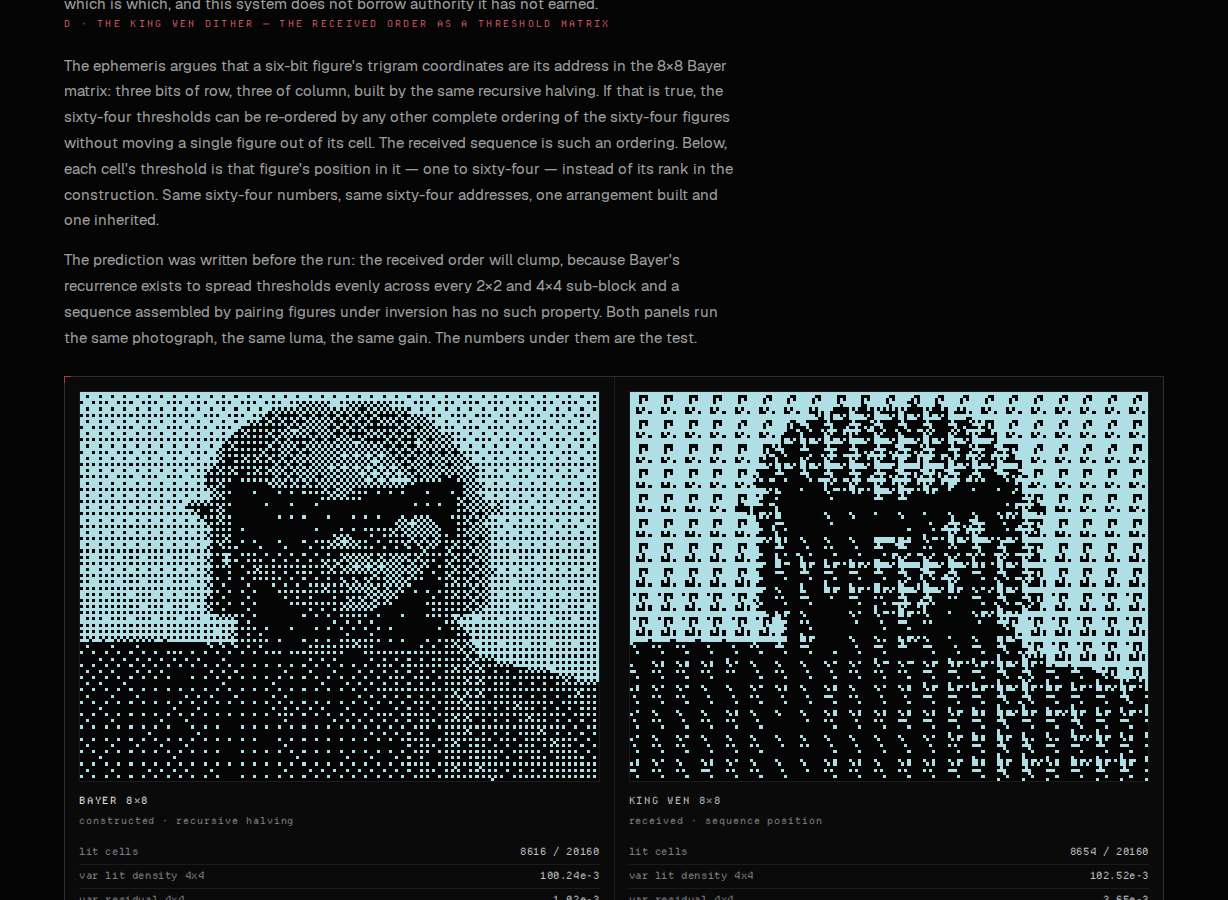
The residual. Local lit density minus local target density is 3.5–5× more variable under King Wen at every gain, and the share of residual power at scales coarser than the tile is 13.27% against 0.80% — a factor of 16.6. The panels show it without a statistic.
Raw 4×4 variance. +2.3%. It measures the photograph, not the dither: a dark region is sparse under any matrix. Reported as asked, and reported as insufficient. On a flat field the same statistic separates the two completely.
Spectral flatness points the other way and stays on the plate with the reason: it measures how evenly power spreads over bins, not which bins. Finding that out is worth more than deleting it. King Wen is as tileable as Bayer — a rival, not a curiosity — and it loses on the measurement, which is now the reason to keep Bayer.
The almanac — a year of weather at one bit per day
Every day of the UTC year derived at noon by the routine that seeds the field, sampled at 288 points, drawn as one phase disc at twelve cells. Three statistics were prototyped and drawn; the one kept is the warm–cold balance the tide gives the day, because it is the only one that is a calendar of this page: lag-29 autocorrelation 0.907 against 0.915 for the moon itself, and 13.8% of its variation survives regressing the moon out. That share is the terrain.
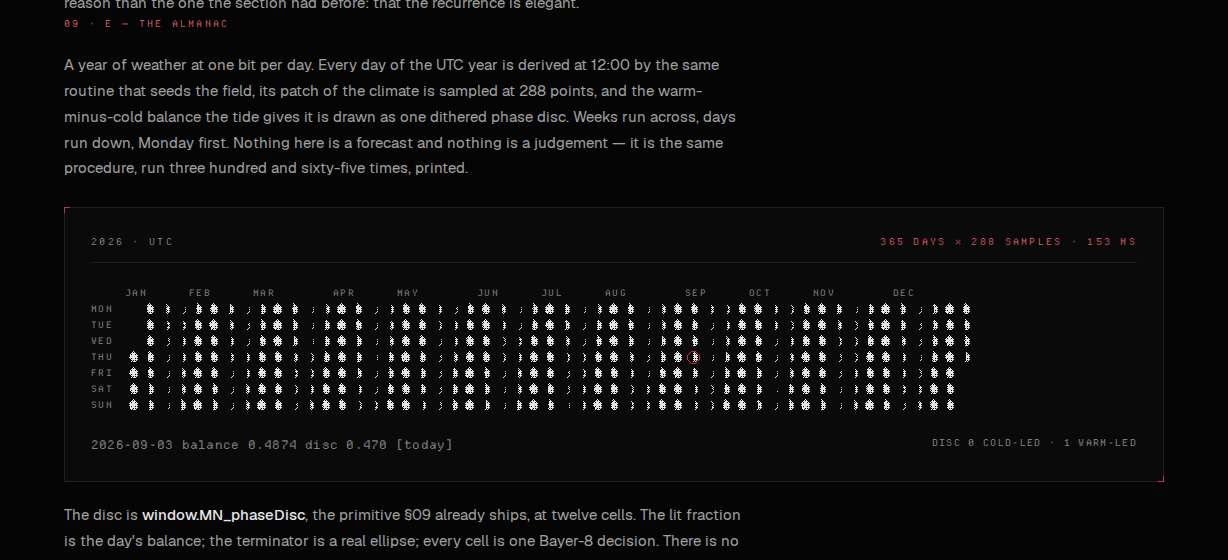
Two blocking items. The first build ringed today's cell in essence — 32 cells of the page's one-dot cyan budget — and fixed the grid at 53 columns, which a leap year starting on a Sunday overflows. The ring is sigil now, opaque and deduplicated so no cell composites twice, and the columns are computed.
Nothing. The grid is painted once into an offscreen canvas and blitted when the cursor moves. There is no animation loop, so reduced motion has nothing to switch off: the reduced picture and the default picture are the same picture, by construction.
The cap counts instruments, not calls. The phase disc's three-use rule forbids the disc as an ornament beside something that did not need it; a calendar whose only mark is a lit fraction is the opposite case, and the canon now says so.
The figure, played
The six-bit figure as six one-bit pulse trains, one per line — a solid line plays its train whole, a broken line half of it, and the gap you see in the drawn line is the gap you hear. The tempo is the planetary hour, so the same figure runs 2.26× faster on a midsummer night than on a midsummer afternoon. Nothing is audible that is not already printed, and nothing exists — no context, no worklet, no node — until listen is pressed.
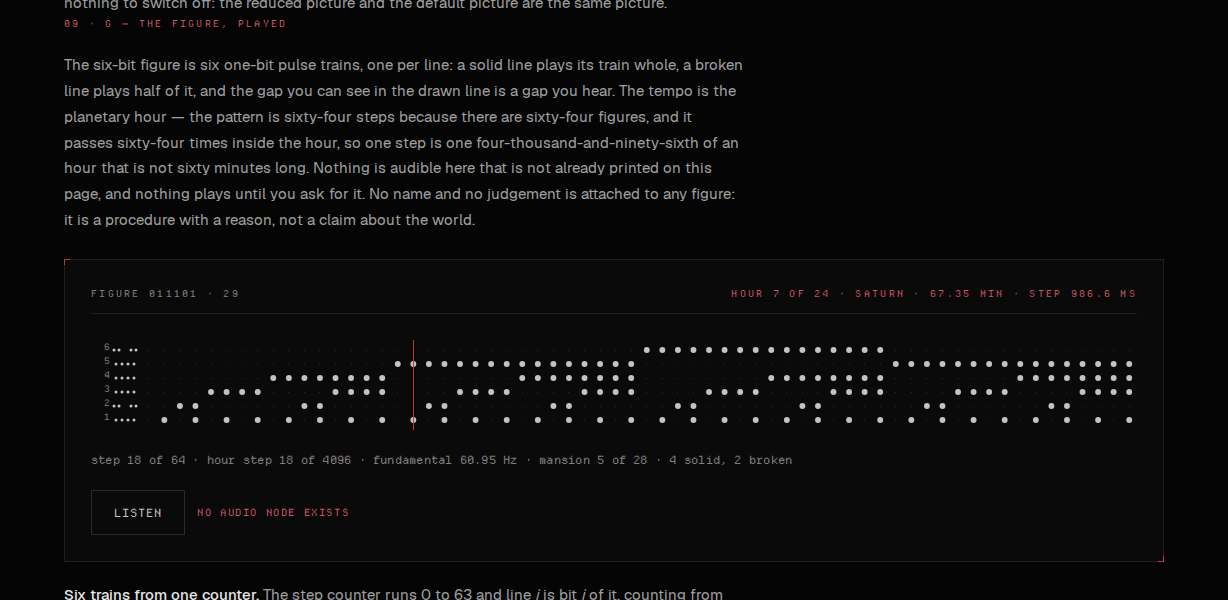
The blocking finding. A fast double-press threw on AudioNode.connect. After the fix: a double-press and an eight-click hammer produce zero errors and the control settles to "no audio node exists". Reduced motion holds the strip static and non-blank while the audio still plays.
The observer. The brief and §9 said the ephemeris computes at 0°N 0°E. It computes at the Royal Observatory, 51.4779°N — the meridian's own fixed point, and a better one, since 0°N 0°E is open water where day and night are always equal and the hours would never be unequal. The canon moved to the code and §16 records it as falsified.
A one-bit stream carries a tone by pulse density through a low-pass, exactly as a count of marks carries a tone on the page. There is no oscillator and no level: the filter is what turns a count of pulses into a pitch. Gain-staged below −18 dBFS and measured there.
Briefed and not built
Three from the first round remain research, recorded rather than dropped: text-mode rendering, a sigil engine, a steganographic layer.